
MMA Fundamentals for Strikers
Your striking is only as good as your ability to stay standing.
The Basics for MMA Strikers
Where should you dedicate your time when it comes to striking for MMA?
MMA Is Not Kickboxing With Takedowns
This is a question I've been asked a lot over the years. We'll focus this piece on striking specialists transitioning into the sport.
MMA is its own beast, and a lot of what you may have practiced in your base discipline — boxing, Muay Thai, kickboxing — won't translate directly under this new ruleset.
But that doesn't mean you throw the baby out with the bathwater.
A punch is still a punch in MMA, and a kick is still a kick. It's the new risks associated with those techniques that will change how you approach using them.
It's about refinement. Basics are key, and the bread and butter techniques can be just as effective in mixed martial arts. It's just the frequency with which you throw them that will change.
You aren't likely to have prolonged back and forth exchanges in MMA, particularly if you aren't fighting another striker. That means if you're a Muay Thai guy, those body kick exchanges are largely a thing of the past. You have to get used to exiting or initiating a grapple on your terms. You're no longer just trading strikes.
Distance Changes Everything
The other major difference is the distance game. Defensively, you may find yourself maintaining more range than usual if you're anxious about being taken down. Offensively, in the small gloves and with the constant threat of the grapple, opponents are far less inclined to stand directly in front of you. That means you've got your work cut out to lead effectively.
Spending a substantial amount of time in training working from distance will help. Make the pad man stand further away and move around far more than you're accustomed to.
Keep yourself accountable in sparring and work from the range you'll spend most of the fight operating from. There's a time and a place for situational rounds in the mid-range or defensive drills at closer quarters, but the majority of your time should reflect the reality of where MMA fights actually happen.
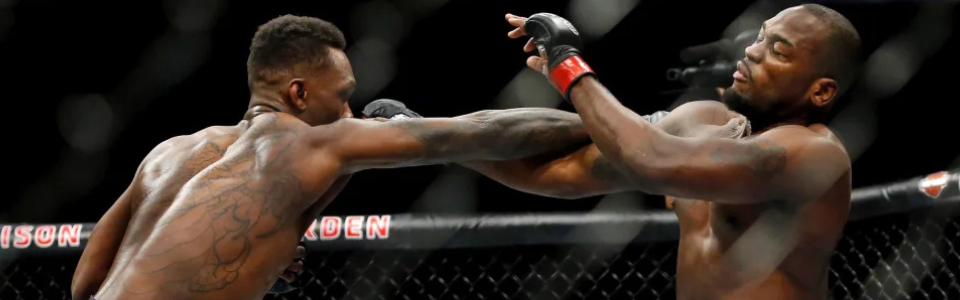
Fig 1. Here you can see how Adesanya has to feint before shuffling in to close distance.
The Problem With MMA Strikers
Now, if you're an experienced striker making the crossover, the first thing you have to get used to is the unpredictability of a less orthodox MMA sparring partner. If they haven't come from a traditional striking background, it's like sparring of fighting a beginner, which can actually be harder to deal with than someone seasoned. They're difficult to read. If they don't know what they're going to do, neither do you. And this isn't a hobbyist.
This is a conditioned athlete, likely the same weight as you, or heavier in the cage if they've cut and rehydrated, who has trained for combat. You could be standing across from a tough, explosive guy with a gas tank, swinging windy hammers your way and kicking you in the shin all night.
We've all had that frustrating spar or fight with someone we are technically superior to, but they've dragged us down to their level. Rather than keep it boring and control the chaos, we've been sucked into it.
The difference between a veteran and a novice is experience, and experience only shows over time. The first ten seconds of a bout can be anyone's game.
Fig 2 & 3 - Tony Ferguson being Tony Ferguson.
Your Bread And Butter Weapons
This is where your basics will really earn their keep. A strong stance, good eyes, responsible defence, and simple sharp attacks. A stinging jab and a spiteful low kick. Use those to break them down and take your opportunities when they present themselves.
All your striking is virtually the same in MMA as it is on the pads in terms of what's available to you, but you need to be more judicious with how and when you deploy it in a fight. You can still train combinations, go full clip on the pads, and work with your boxing or kickboxing coach in that context. Use those sessions for what they are. But when you step back into MMA rounds, be more mindful, otherwise you risk spending an entire round pinned on the bottom, or catching a haymaker in the clinch from someone in small gloves.
Interest compounds over time, so the more mat time you accumulate the more of those finer details you'll naturally pick up. If you train consistently, multiple times a week, for five to ten years, you'll get there. But if you approach it as a speed run to learn everything at once you'll get frustrated and burn out. That's not the mission right now.
The mission is simple.
Your striking is only as good as your ability to stay standing, and your grappling only needs to be good enough to get you back there.
Figure 4. We see Chuck Liddell demonstrating some old school Sprawl and Brawl tekkers.
Figure 5. Tito beats Chucks first line of defense, the hands, and gets in on his hips. Chuck manages to hip out and bring Tito up and off of his legs. Note that as he is actively defending the takedown he is circling to avoid getting backed to the cage wall.
Stay Disciplined
If you enter the exchanges with the ego that you're the striker, you are playing with fire. That is how strikers get knocked out or dropped by grapplers. You have to treat every opponent with respect, particularly in the early going. Use your fundamentals to take the sting out of them first. Make them swing big and miss with a few feints and proper distance control. That doesn't mean you can't throw with intent to hurt.
If you can throw a hard straight right to the body or pump a stinging jab that splits the guard and gives them a white flash, you do it. But you still dot your i's and cross your t's. Use high percentage shots with a set up or at the least understand your range.
Go through your process, be ready to break off from a bum rush if needed, and don't rush in.
Below Figure 6 & 7 - We can see Adesanya using feints before jabbing Brunson to press him back. He is controlling the range. Brunson dives in from too far away allowing Israel the time to see and defend the rushed attempt.
In the following sequence we see Israel disengage but rush back in only for Brunson to reshoot. Now Adesanya has to seperate all over again. The only advantage here is by forcing the wrestler to work you will tire them out. However this relies on you being able to disengage from the grapple.
The Grappling Side
With that in mind, when it comes to the grappling I'd put the majority of your time into four areas:
-
First-stage defence. Sprawling and developing your reactions to defend double and single leg entries.
-
Cage defence. Working against the fence is a different game altogether and deserves its own dedicated time.
-
Pin escapes and get-ups. Getting back to your feet efficiently is non-negotiable.
-
Basic submission defence. Staying safe as you work through positions.
First-stage defence is both the easiest and the hardest, depending on your athleticism. Jose Aldo is the best example of an elite athlete who is near impossible to take off his feet. His reactions are exceptional, and when he does hit the mat he's usually back up immediately because of his explosiveness. If you have good hips and sharp reaction time you'll save yourself enormous amounts of work. Combine that with a basic understanding of positioning and a feint game that disrupts timing, and you'll be off to the races.
Figure 8. Aldo Hip Heisting Figure 9. Fantastic sprawl
Get-ups also have a significant athletic component. If you're explosive, strong and fast, you can muscle your way through a lot of jiu-jitsu. I've seen fighters stand up from mount on pure physicality alone. The more technical element is developing a feel for your opponent's weight distribution and finding the space to manoeuvre. You need both, but at an entry level I'd invest equal time into becoming a better athlete and learning the fundamental principles. You haven't got time to pursue a black belt in the Gi during an eight-week camp.
The submission defence in the main falls into staying safe whilst getting up. Not leaving limbs or your neck exposed as you progress a position back to your feet. At this early developmental stage you shouldn't be planning to play much guard. Your goal is to be effective with your striking in MMA. Everything should revert back to that mission statement when you ask yourself, why am I doing this?
Figure 10. Nathias Frederick muscling James Wood off of him in his Cage Warriors World Title win. What Frederick lacked in skill he made up for in abundance with determination, strength, and a street fighting mentality.
The Most Important Skill: Breaking Grips
The single most important grappling skill for a striker in MMA is learning to separate the hands. If you can't create space from guard and leg press an opponent off you, most escapes will involve giving up your back and working towards the fence from the ground.
If your first-stage takedown defence is solid, the majority of the time a determined wrestler will chain to a body lock. That means pummelling or breaking grips, and I'd favour breaking grips above all else. Once the grip is gone, you'll escape.
Pummelling keeps the opponent connected to you and risks surrendering your hips for a body lock takedown or a Greco-style trip off the cage - that said, with good awareness and understanding it is still an effective means of defence.
Figure 11. Here we can see Fabian Edwards giving up his back to fight the hands against Johnny Eblen. Fabian is using the cage to lean against for balance and is focusing his attention on splitting the grips. Depending on the type of grip the opponent has (gable/ S-grip) will depend on how you can best separate the hands. Once the grip is broken Fabian keeps both of his hands on one of Eblens to prevent him from re-wrestling. This forces Eblen to abandon the grapple and disengage.
An Example of Pure Muay Thai in MMA
Sam Bark is an excellent example of a pure striker transitioning successfully into MMA, and ironically it was his striking that found difficulty against other MMA strikers rather than him being exposed by grappling!
Sam had an extensive Muay Thai career, living in Thailand for over three years and accumulating a record of over 50 fights. He enters the cage in high split shorts, bouncing the lead leg like it's Lumpinee stadium circa 1995. The man is a Muay Thai fighter to his bones.
Figure 12. Sam living up to his nickname "Sammon Decker", in tribute to Ramon Deckers, walking across the cage to his opponent like he is in a Bangkok Stadium.
The early days of Sam's MMA career were littered with wrestlers hell bent on taking him down, and some of them succeeded. That is the reality of the transition. You will get taken down. You will end up in bad positions. The question is what you do when it happens and how quickly you can make it uncomfortable for the person who put you there.
Sam abided by two golden rules that kept him competitive through that learning curve:
- Never accept a takedown or bad position. Keep things moving
- Fight the hands.
The first rule is about mentality as much as technique. The moment you stop scrambling is the moment you give a wrestler permission to settle in and go to work. Stay active, stay uncomfortable to hold, and keep progressing even if the position isn't perfect.
The second rule is the practical application of everything we talked about earlier. Fighting the hands means disrupting the grip before the shot fully develops. Controlling the wrists in the clinch. Denying the connection that makes the takedown possible in the first place. You can't drag someone down if you can't get hold of them. Sam's Muay Thai background actually served him well here because he understood the clinch and hand fighting from his time in the sport, just applied under a new ruleset.
The result was a striker who didn't abandon what made him dangerous. He just built a fence around it.
Fig 13. Sams opponent, Baysangur Makaev, is a wrestler from the Allstars gym in Sweden (Khamzat Chimaevs orginal team).
Fig 14. The opponent relentlessly persues the takdedown and Sam is forced to give up his back. He immediately fights the hands. By separating the hands he can disengage.
Figure 15. Sam intercepts the opponent with a flying knee, knocking him spark out.
Conclusion: Keep It Simple
The instinct to want to work on everything at once is completely natural, especially the closer a fight gets. But the answer, as unglamorous as it sounds, is to narrow your focus rather than widen it.
For a striker preparing for an MMA debut, your job is simple on paper. Don't get taken down, get back up if you do, and when you're standing, be dangerous. Every hour you spend in training should be in service of that. Not every submission from every position. Not a full Muay Thai camp. Not mastering the clinch game overnight. Just the fundamentals that keep you upright and give your striking room to breathe.
The good news is that you don't need to reinvent yourself. The striking you've spent years building is still your greatest weapon. It just needs some adaptation for the new environment. Trust it. Refine your positioning, keep your entries and exits sharp, and let the jab do the talking until better opportunities open up. The fighters who make the smoothest transitions to MMA aren't the ones who became decent grapplers overnight. They're the ones who made themselves hard to hold down, hard to finish on the ground, and absolutely dangerous the moment they found space to work.
Keep it simple. Stay on your feet. Be yourself.